
The Meaning of Wedding Flowers: A Bride's Guide to the Language of Flowers

Updated: Sep 30
Long before Pinterest boards, the Victorians used flowers to send messages. Every bloom carried a meaning, and a well-chosen bouquet could say what couldn't be said out loud. They called it floriography, the language of flowers.
It's having a revival in 2026, with Victorian-inspired bouquets of lily of the valley and calla lilies showing up everywhere (see our 2026 wedding flower trends). And it's one of the most meaningful ways to make your bouquet feel like yours.
Here's what some of the most-loved wedding flowers mean.
Popular wedding flowers and their meanings
Rose: Love, above all. Red roses signal passionate love, white roses purity and new beginnings, pink roses gratitude and admiration, and garden roses a romantic, abundant love.
Peony: A happy marriage, good fortune, and prosperity. It's no surprise peonies are a bridal favorite.
Lily of the valley: The return of happiness. A classic royal wedding flower, delicate and fragrant.
Calla lily: Magnificent beauty. Sculptural and elegant, and one of the defining flowers of 2026.
Ranunculus: Radiant charm. Layer after layer of tissue-thin petals.
Tulip: Perfect love and a declaration of devotion.
Myrtle: Love and marriage. Royal brides have carried a sprig of myrtle in their bouquets since the Victorian era.
Orange blossom: Eternal love and fertility. Queen Victoria famously wore it in her hair on her wedding day.
Baby's breath: Everlasting love and innocence.
Sweet pea: Blissful pleasure and a "thank you for a lovely time."
Gardenia: Secret love and joy.
Lavender: Devotion.
Hydrangea: Heartfelt emotion and understanding.
Eucalyptus: Protection and healing, a lovely wish for a new marriage.
Ivy: Fidelity and wedded love, which is why it's traditionally woven into bridal bouquets.
Flower meanings vary between sources and cultures, so treat these as a starting point for your own story.
How to use flower meanings in your wedding
Build your bouquet around a message. Choose one or two flowers whose meanings you love and ask your florist to feature them.
Honor someone you love. Include your grandmother's favorite flower, a bloom from your mom's wedding, or a flower from your childhood garden.
Tell guests the story. Add a line to your program or a small card at the sweetheart table explaining what your flowers mean.
Give each bridesmaid a meaning. Tuck a different symbolic bloom into each bridesmaid's bouquet with a note.
Write it into your vows. If you're writing your own vows (most couples are now), a line about the flowers you chose and why is a lovely detail guests remember.
Choose what grows here. For a New England wedding, flowers in season (lilacs and lily of the valley in spring, peonies in June, hydrangeas all summer on the Cape and South Shore) are fresher, and a sweet nod to where you're getting married.
A message worth keeping
Here's the thing about a bouquet full of meaning: it's built to fade. Fresh flowers last a few days at most, and then the message is gone.
Unless you keep it.
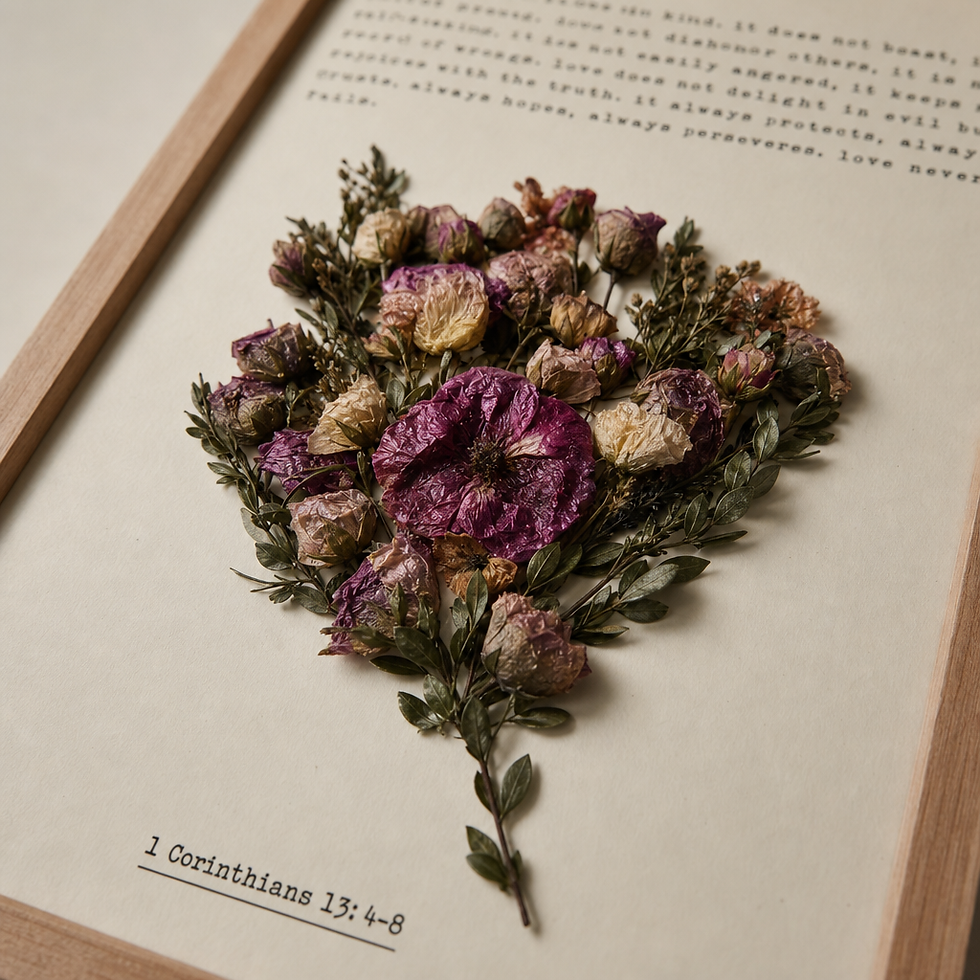
When we preserve a bouquet at ADONIA Studios, we deconstruct it by hand and press each bloom so it keeps its shape and depth, then rebuild it in a frame. The peonies you chose for a happy marriage, the myrtle for love, the ivy for fidelity: they all come home with you and hang on your wall. You can even add your invitation, your wedding date, or a handwritten note about what each flower means.
It's the language of flowers, made to last. Not a craft project, and not a dried bundle in a closet: a piece of art that looks like it was always meant to be on your wall.
From the studio: I'm Chelsea, and I preserve every bouquet by hand in my studio on the South Shore of Massachusetts. If you're building a bouquet around a meaning, tell me when you book. I love designing the frame around your story.
Fun fact: our name comes from the ancient Greek Adonia festival, where fast-blooming gardens were planted knowing they would quickly fade, a symbol of beauty's brevity. At ADONIA Studios, our work is about reversing that. Read our story.


Comments